Nicholas Hawksmoor: Gone, and For Too Long Forgotten
On this day in 1736 British Architect, Nicholas Hawksmoor, died.
Those of you who’ve read And by Fire know that, while he never makes a physical appearance in the novel, this mentee of Sir Christopher Wren is an important character in the book. Wren took Hawksmoor on as a clerk when Nicolas was a mere eighteen years old. It speaks to his talent that Wren had already heard of the young man’s ‘early skill and genius’ for architecture. Between approximately 1684 and 1700, Hawksmoor worked with Wren on projects including Chelsea Hospital, St. Paul’s Cathedral, Hampton Court Palace and Greenwich Hospital.
At the turn of the century Hawksmoor began to assist one of the other fashionable architects of the day, John Vanbrugh. His work with Vanbrugh saw Hawksmoor involved in the building of Blenheim Palace for John Churchill, Duke of Marlborough, and Castle Howard for the 3rd Earl of Carlisle.
Shortly after working withy Vanbrugh, Hawksmoor started taking commissions on his own. His style differed from both the prominent men he had previously worked with. Hawksmoor had never traveled abroad and therefore was not influenced by Italianate fashion. And he ultimately made his name with church and university architecture rather than building houses for the wealthy.
All Soul’s College, Oxford, (1716-35) is likely Hawksmoor’s finest University work. There he built the exterior of a new Hall and Library in Gothic style to blend harmoniously with the surviving medieval buildings, but the interiors were pure classical form. St. Mary Woolnoth, in the City of London (the 1 square mile that is), is an excellent representation of his ecclesiastical designs, while also being the least conventional of all Hawksmoor’s churches. As a historical aside, it was the only Church within the City of London proper (again the 1 square mile) that survived the Blitz entirely unscathed.
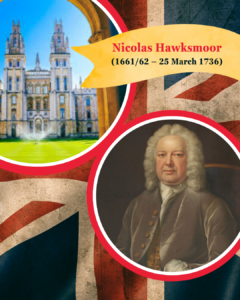
While he was known in his era, unlike his mentor, Wren, Hawksmoor “disappeared” and became virtually unknown after his death. A fate that is both tragic and unfair.
As the American Institute of Architects said in article (March 2016):
“Artistic reputations often rise, fall, and shift over time. Shakespeare, for instance, was once regarded as an uneducated bumpkin (a “poet of nature,” as Samuel Johnson wrote). Contemporaries of the English painter J.M.W. Turner dismissed his abstract late works—now celebrated—as symptoms of senility. (John Ruskin, otherwise a fervent admirer, lamented that they were “of wholly inferior value.”)
Even amid this context, the fall and rise of Nicholas Hawksmoor is an astonishing story. The master of the English Baroque—who worked on St. Paul’s Cathedral alongside Sir Christopher Wren, left several other incomparable churches looming over London, and collaborated with Sir John Vanbrugh on the grand country estate of Castle Howard in North Yorkshire—was nearly lost to history. Critics long portrayed Hawksmoor as a minor and eccentric talent, an assistant to Wren and Vanbrugh who couldn’t match them in any respect.”
The tide began to turn for Hawksmoor thanks to the pioneering research of an architectural historian named Kerry Downes, and the formation of the “Hawksmoor Committee,” a coalition of arts patrons, writers, and architects who lobbied to save Hawksmoor’s dilapidated churches from oblivion.
But a reputation—architectural or otherwise—can’t be restored overnight. After decades of activism and research Hawksmoor’s rehabilitation continues and the quest to make him to Britons after hundreds of years of obscurity continues.
